|
Oil on canvas, 48 x 84 inches
CR No. 1618
|
Gift of The Georgia O'Keeffe Foundation
2006.5.476
|
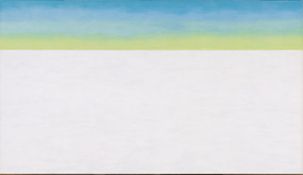
Horizontal abstract representation of gray matter in bottom 3/4 with strong yellow band which lightens surmounted at very top by blue band.
CR No. 1618
Title (1999 Catalogue Raisonné)
Sky Above Clouds/Yellow Horizon and Clouds
Source of title: inclusion in series.
General Remarks
Not recorded Whitney Archive, Downtown Gallery Archive, Abiquiú Notebooks. See cat. nos. 1460, 1478, 1479, 1482–84, 1498. Painted with assistance of Belarmino Lopez. (Source: Lynes, 1999)
Inscriptions
Stretcher: inaccessible Verso: inaccessible (Source: Lynes, 1999)
Technique
Oil Painting
Materials
Oil on canvas
2011–2012
2018–2019
Crystal Bridges Museum of American Art
North Carolina Museum of Art
New Britain Museum of American Art
2021–2022
Museo Nacional Thyssen-Bornemisza
Centre Georges Pompidou
Fondation Beyeler
2022–2023
Estate of the artist, 1986
Georgia O’Keeffe Foundation, 1993
Gift to Georgia O’Keeffe Museum, 2006
(Source: Georgia O'Keeffe Museum, 2025)
© Georgia O'Keeffe Museum
Version History
Core fields last updated 7/2/2026
Last verified by current collection
Source System ID
1491
| Date | Field | Changed From | Changed To |
|---|---|---|---|
| mm/dd/yyyy | Artist | Changed from data | Changed to data |
| mm/dd/yyyy | Main title | Changed from data | Changed to data |
| mm/dd/yyyy | Year | Changed from data | Changed to data |
| mm/dd/yyyy | Media | Changed from data | Changed to data |
| mm/dd/yyyy | Credit line | Changed from data | Changed to data |
| mm/dd/yyyy | Provenance | Changed from data | Changed to data |
Conservation
Information is from the most recently submitted report, please contact the current owner to verify updated details.Support: The support is a medium-weight, relatively open, coarsely spun, basket-weave, 2 x 2 cotton canvas over a butt-joined, expansion-bolt, 6-window stretcher with two vertical crossbars and one horizontal. The warp is oriented vertically, and the painting has been stapled to the stretcher. The canvas wraps around to the back of the stretcher and is tacked down with blued tacks.
Ground or Support Preparation: The artist or her assistant appears to have applied a dilute protein size, such as rabbit-skin glue or gelatin, followed by a priming of alternating layers of lead carbonate (PbCO3) in oil and zinc oxide (ZnO) in oil. The priming appears to be applied in limited coats without sanding.
Design Layers: The work is executed in generally single-layer, thinly applied paints, with the canvas/or support surface occasionally visible. There is linear brushwork at the margins of the forms, with localized wet-in-wet blending, and occasional holidays are present. There are many holidays (skips) in the application of the paint, with low regions of the canvas weave skipped over by the application of the paint, allowing the primer to show through. This imparts a somewhat "pitted" or damaged appearance. This is simply the nature of the artist's original application of the paint. The artist's subtractive scraping or rubbing is evident, particularly in the blue and yellow of the sky. The artist's dry-brush burnishing is also visible. Note that the artist's subtractive removal of paint to provide a modulation of paint thickness and value may appear as abraded damage, but is not.
Surface Coating: There is no varnish on the painting.
Framing, Backing, and Hanging Hardware: The work is installed in a micro-environmentally controlled Georgia O'Keeffe/George Of-designed, "L"-profile, painted aluminum microclimate frame. The frame has a gasketed secondary backing basswood strainer and gasketed Optium glazing and Rhapid gel RH buffering sheets behind corrugated MicroChamber board dust covers to maintain a 45% relative humidity and activated charcoal-zeolite VOC scavenger. Glazed with non-reflective, conductive Optium acrylic glazing.
Due to the extremely matte nature of the paint, scuffs, handprints, and abrasions are easily visible. The work is moderately taut and in-plane. The artist also executed the work with many studio inclusions such as brush hairs, dog hair, and dried paint bits from the palette, all resulting in surfaces in the paint that sometimes appear as scratches, abrasions, and disruptions. Three small flake paint losses, previously noted, are located on the left side near the bottom, one on the left edge nearby, and one on the bottom edge near the viewer's right corner. These all remain stable.
There is a stretcher bar crease with intermittent hairline scratches along the viewer's left edge, and stretcher creases visible on the inside stretcher rail edge in the lower left corner and at the midpoint-horizontal near the right side. There are handling finger smudges dispersed across all edges. Canvas pliers' indentations crease the canvas on the left edge at the margin of the white and yellow background paints. The matte white foreground paint was applied as a stiff, paste-like paint and retains "holidays" or small unpainted skips in the low relief interstices of the canvas texture. These are prominent above the horizontal stretcher bar crack at the viewer's lower left and should not be confused with pinpoint surface losses. Tiny, sand-grain-sized micro-protrusions of carboxylate soaps are generalized throughout most of the painted surface. Aggregated across the blue-green-yellow background, in three broad areas, are many high-relief or prominent threads in the canvas weave that have a tan or brownish appearance. In normal viewing, the appearance suggests soiling. Under magnification, the brown color is a result of pinpoint paint losses at the thinnest paints on high threads in the weave, precipitated by the formation of carboxylate metal soaps.
DOWNLOAD IMAGE
Terms of use
The Georgia O'Keeffe Museum is dedicated to fostering access to its collections to inspire education, research, and creative engagement. Through Access O'Keeffe, the Museum’s digital catalogue raisonné project, we provide free tools for engaging with Georgia O'Keeffe’s full body of work. As part of this initiative, we encourage the download of low-resolution images for educational and fair use purposes.
Certain works by Georgia O'Keeffe are under the copyright of the Georgia O'Keeffe Museum, while others are managed by different rights holders. For commercial uses, users must seek authorization directly from the respective copyright holder.
By downloading and using these images, users agree to the following terms and conditions of use including the Museum’s reproduction guidelines. Users will play a vital role in preserving the integrity of the artist’s work while supporting broader public access.
Permitted Uses
Fair Use:
Images may be used under fair use principles for purposes such as:
- Educational: Use in teaching materials, presentations, and coursework
- Research and scholarship: Academic research articles, theses, dissertations and noncommercial publications
- Creative projects: Reference or inspiration for personal artwork, such as sketches, paintings, or digital art, if the works are not sold or used commercially.
Conditions of Use
By downloading images of artwork from Access O'Keeffe, users agree to adhere to the Museum’s reproduction guidelines for artwork by Georgia O'Keeffe. Images must not be altered, manipulated, or modified in any way that compromises their integrity or misrepresents the original work. Specifically, artworks may not be cropped, distorted, or subjected to the following alterations:
- Cropping
- Rotation, inversion, or changes to the original proportions
- Color adjustments
- Superimposition of text, graphics, or other elements
- Animation, cartooning, or other forms of reinterpretation
- Removal or modification of blemishes, inscriptions, or other original features
- Printing artwork on 3D materials, including fabrics
Unauthorized Uses
Unauthorized uses of Georgia O'Keeffe’s works include any applications that fall outside the scope of fair use, such as those intended for commercial profit generating purposes.
Examples include, but are not limited to:
- Publications and merchandise that are sold or generate income.
- Reproductions in marketing materials, advertisements, or promotional campaigns.
- Use in exhibitions or displays that charge admission fees.
For any such uses, prior written authorization must be obtained from the appropriate copyright holder noted in Access O'Keeffe.
For any commercial use, prior written permission is required from the copyright holder. Please contact the Digital Experience and Rights Manager at [email protected]
ADD TO LIST
COPY CITATION
Georgia O'Keeffe. Sky Above Clouds/Yellow Horizon and Clouds, 1976–1977. Access O’Keeffe, Georgia O’Keeffe Museum, https://access-ok.okeeffemuseum.org/object/1491.